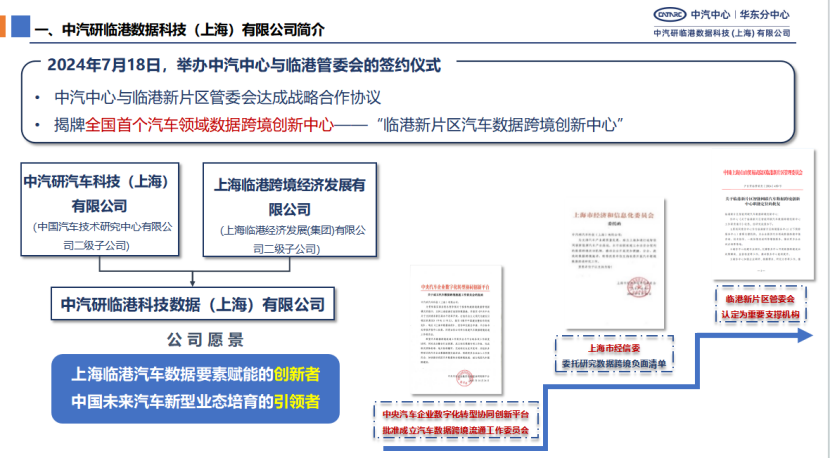
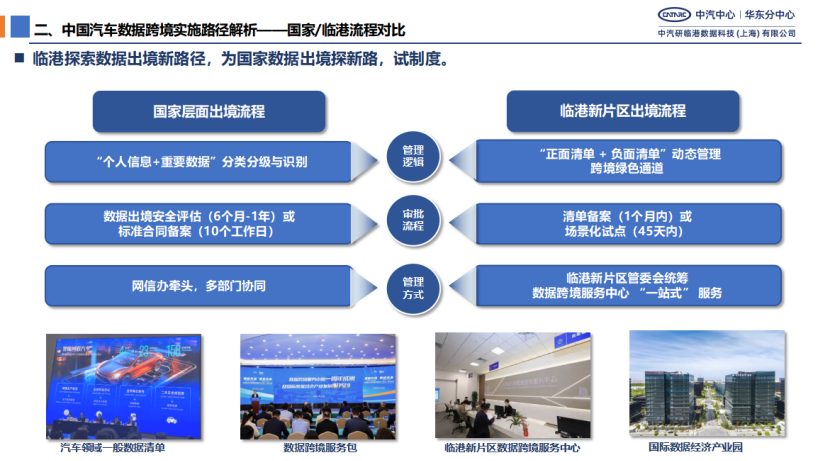
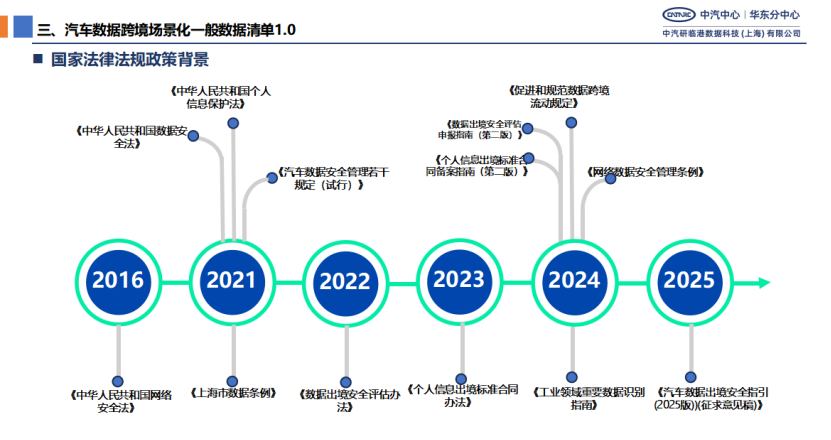
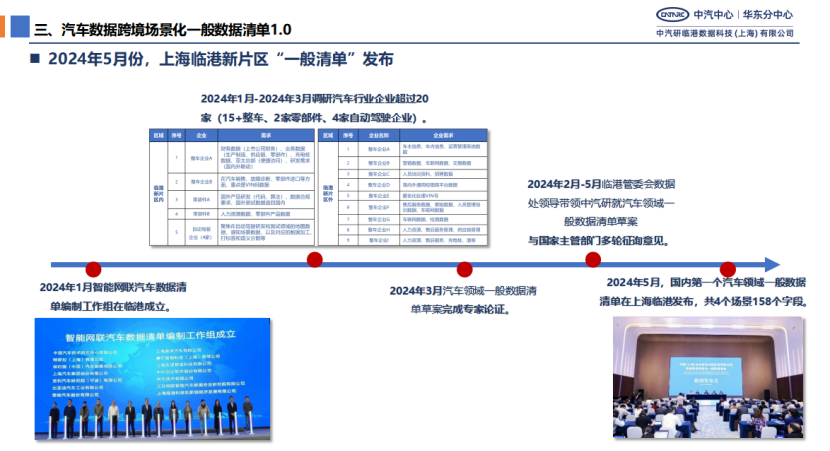
In May 2024, Shanghai's Lingang New Area released the 'Cross-Border Data Scenario General List 1.0', aimed at addressing the urgent cross-border needs of automotive companies in manufacturing, research and development, after-sales, and used car export scenarios. The innovative technology of decoupling VIN numbers from personal information, along with breakthrough policies for the outbound transfer of software and hardware version numbers in after-sales services, showcase the pioneering value of Lingang's policies. Additionally, China Automotive Research's Lingang Data Technology is actively involved in the development of operational guidelines for cross-border automotive data scenarios, as well as guidelines for new energy battery data operations, in response to the strict requirements of the EU Battery Regulation regarding the disclosure of battery lifecycle data. Zhao Zihao, the technical director of China Automotive Research Lingang Data Technology (Shanghai) Co., Ltd., noted that the Lingang New Area is exploring innovative paths for data export, serving as a pilot for national cross-border data management. He explained the compliance points and operational innovations in data export processes from both the national policy framework and Lingang's practical explorations. The company, established in 2024 as a joint venture between China Automotive Research and Shanghai Lingang Cross-Border Economic Development Co., Ltd., has been recognized as a core support institution for automotive data cross-border operations. It has been tasked by the Shanghai Municipal Economic and Information Commission to develop a negative list for automotive data cross-border operations and has led the establishment of the 'Automotive Data Cross-Border Circulation Working Committee'. In July 2024, China Automotive Research and the Lingang Administrative Committee jointly unveiled the first national innovation center for cross-border automotive data, creating a comprehensive capability that covers policy research, scenario pilot testing, and compliance services. The Lingang New Area has pioneered a 'dynamic management of dual lists + scenario pilot' mechanism, which significantly reduces the typical cross-border data security assessment cycle from 6-12 months to under one month for general data lists and allows special scenario pilots to be approved within 45 days. A 'Cross-Border Data Service Center' has also been established to provide one-stop services, integrating registration review, data preservation, and field verification. In January 2025, the company assisted Ford in completing the first national case of after-sales service data cross-border filing, achieving full-process validation from field review to consistency checks. The practical implementation of the 1.0 list has addressed three core needs: the return of manufacturing data from multinational companies' Chinese factories to headquarters, the return of overseas vehicle diagnostic data to domestic R&D centers, and the cross-border transfer of complete vehicle condition information necessary for used car exports. For instance, in the Ford after-sales case, 23 types of data fields transmitted underwent field-level compliance verification and were ensured consistency through a monthly preservation sampling mechanism. Looking ahead, the company plans to release version 2.0 of the list in 2025 to meet new demands from automotive companies, expanding the data fields included in the research and testing scenarios. The new version will introduce additional data on auxiliary driving road collection and desensitized data from closed testing for R&D testing scenarios, data on vehicle bus and auxiliary driving event data from diagnostic devices for after-sales, and the health status of new energy vehicle batteries for used car scenarios. Additionally, three new scenarios will be explored: vehicle software upgrades (OTA) with 29 fields to resolve cross-border upgrade package blockages; intelligent driving scenario libraries with eight types of simulation testing data; and a new energy vehicle charging scenario covering nine fields such as charging pile fault diagnosis. A significant breakthrough will be made in lifting the restrictions on OTA data export. Current policies classify OTA upgrade package source codes as important data, preventing overseas vehicles from receiving upgrade packages. The 2.0 list will define compiled software packages as general data, allowing them to be exported through the registration channel. In the intelligent driving scenario, V2X message data and desensitized testing data recognized by the state will be included in a green channel to support global collaborative R&D among automotive companies. To tackle the EU's battery passport legislation set to be implemented in 2027, the company, in conjunction with the Lingang Administrative Committee, has initiated the development of battery data operation guidelines. This legislation mandates the disclosure of battery lifecycle data (carbon footprint, material sources, ESG indicators), but full disclosure could expose sensitive supply chain information. Currently, a three-layer response system is being established: a whitelist for data export, clarifying which fields are exportable and the obfuscation rules; the establishment of a unified data export platform to collect corporate data through standardized interfaces; and the integration of the 'China Battery ID' platform with the EU certification system to promote mutual recognition of standards between China and the EU. Presently, two major challenges exist: the need to improve the protection mechanisms for sensitive data such as the source of battery minerals and core process parameters, and the lack of EU recognition for assessment reports issued by domestic certification bodies. Moving forward, efforts will be made through the battery passport alliance to foster industry collaboration, establish a graded data protection model, and work with government departments to advance negotiations for mutual recognition between China and the EU. The Lingang New Area will continue to iterate the scenario lists, focusing on new cross-border data needs such as high-precision mapping and integrated cabin driving. It is recommended that automotive companies establish a three-phase compliance pathway: prioritize the registration of basic data under the general list, implement 'domestic pre-processing + field desensitization' for R&D data, and explore scenario pilots for sensitive data. The industry must collectively advance the establishment of data asset pricing and cross-border mutual recognition mechanisms, promoting the globalization of the automotive industry while ensuring national security.
Shanghai Launches 1.0 Version of Cross-Border Automotive Data Guidelines

Images
Share this post on: